Managing Online Reviews Across Multiple Locations: A Playbook for Multi-Location GTA Businesses
Managing reviews across multiple locations isn't the same problem multiplied. It's a different problem entirely. Here's the full playbook for GTA multi-location and franchise businesses.
Tanzim Hoque · July 16, 2026 · 9 min read
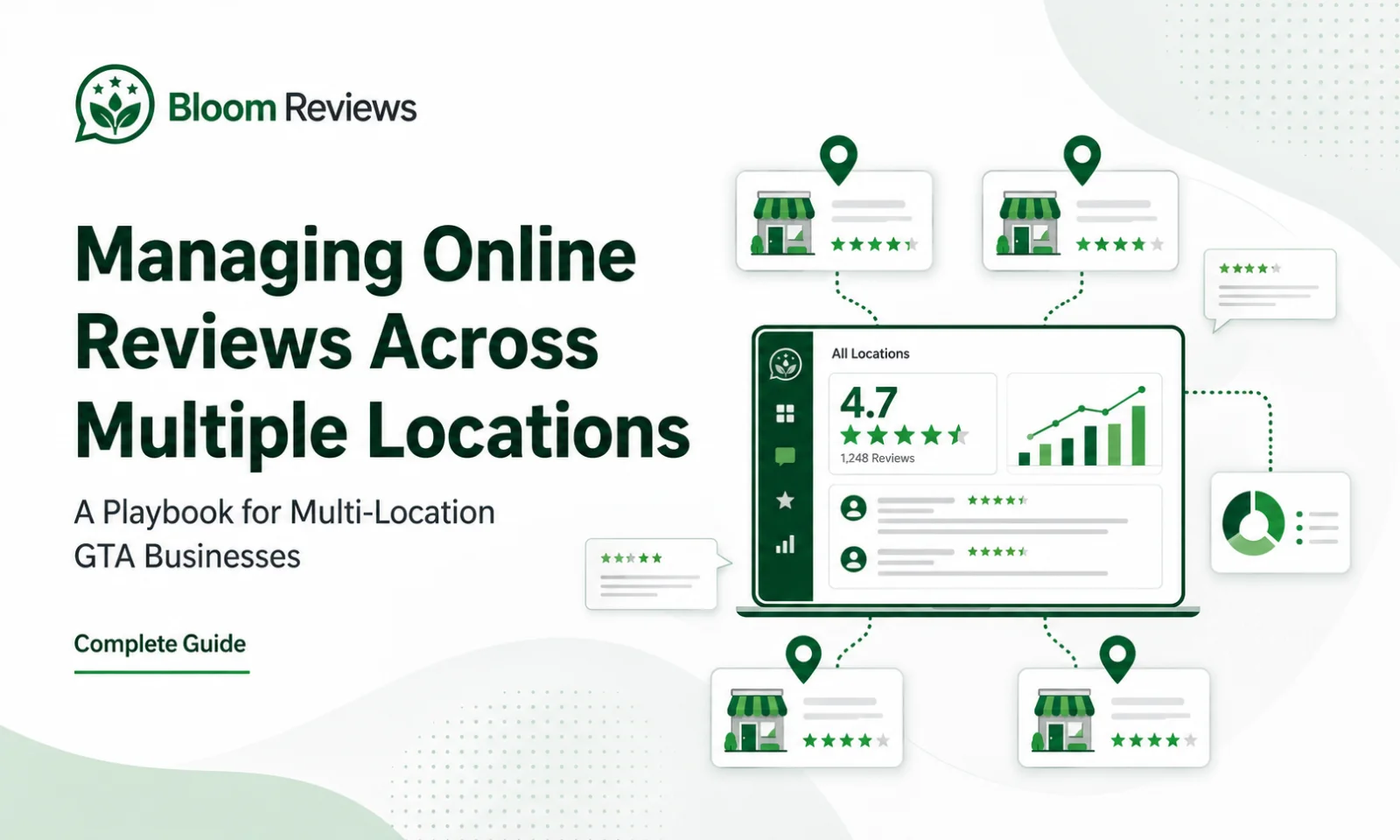
Managing Online Reviews Across Multiple Locations: A Playbook for Multi-Location GTA Businesses
One location with a review problem is a fixable issue. Nine locations with an inconsistent review problem is an operations problem wearing a marketing costume, and it needs a different kind of fix.
Tanzim Hoque, Founder of Bloom Reviews · July 2026
We recently worked with a nine-location medical aesthetics group operating across Mississauga, Brampton, and Toronto, and the pattern we found is close to universal for multi-location businesses: some locations had 40-plus reviews, others had four. Not because the newer or smaller locations were doing worse work, but because there was no consistent process ensuring every location asked for reviews the same way, at the same rate, regardless of which staff happened to be on shift.
That gap is the actual problem worth solving, and it looks different from a single-location review strategy in a few important ways that most multi-location operators don't fully account for until they've already lost months of ground at their weaker locations.
Why Multi-Location Reviews Are a Different Problem
Google ranks every location independently. Your Mississauga location competes against nearby Mississauga businesses in the Local Pack; your Brampton location competes against an entirely different set of nearby competitors. A strong review profile at one address does nothing for another, which we cover in more depth in how many Google reviews do you need to rank. This means a nine-location brand isn't running one review strategy, it's effectively running nine separate ones simultaneously, even if the underlying process and standards should be identical across all of them.
Inconsistency is more visible than low volume. A single business with modest reviews doesn't stand out as unusual to a customer or to Google's algorithm. A brand with nine locations where three look thriving and six look neglected sends a confusing signal, both to customers comparing locations before choosing which one to visit, and to Google's ranking algorithm evaluating each profile's activity level independently. A prospective customer who notices one location has 200 recent reviews and another has 12 from two years ago may reasonably wonder whether service quality varies as much as the review counts suggest, even when it doesn't.
The failure point is almost always process, not effort or service quality. Individual location managers or staff members remembering to ask for reviews works inconsistently by definition, some remember consistently, some forget during busy weeks, some never build the habit at all, and turnover resets progress at whichever location just lost its most diligent staff member. This isn't a motivation problem, it's a structural one, and treating it as a motivation problem, more encouragement, more reminders, tends not to fix it.
The Core Fix: Standardize the Process, Not Just the Goal
Telling every location manager "get more reviews" produces the same uneven result you already have, just with more pressure attached and no actual change in mechanism. What actually closes the gap is removing the dependency on any individual remembering to ask, at every single location simultaneously.
One consistent request mechanism across every location. Whether that's a QR code, a text-based follow-up, or another method, the mechanism needs to be identical at every address so results aren't dependent on which manager happens to be more diligent that particular month.
Location-specific tracking, reported centrally. You need visibility into which locations are keeping pace and which are falling behind, ideally before the gap becomes a six-month problem rather than a six-week one. A simple monthly dashboard comparing review count and recency across all locations tends to surface problems well before they'd otherwise become visible to customers or leadership.
Compliant collection, uniformly applied. Google's 2026 policy update specifically targets pre-screening and staff-driven review campaigns, both patterns that tend to creep in at the individual-location level when managers improvise their own approach without central oversight. See Google's 2026 review policy update for exactly what's now prohibited, since a single non-compliant location can, in theory, trigger enforcement patterns that draw scrutiny to the whole brand, particularly if several locations show similar irregular patterns around the same time.
Consistent employee and disclosure policies across every location. With a larger combined staff across multiple sites, the risk of well-intentioned but non-compliant staff review activity multiplies, covered in more depth in can you ask employees to help get reviews. A single centrally communicated policy prevents this from becoming nine separate, inconsistently enforced local interpretations of what's allowed.
What This Looked Like in Practice
For the nine-location group mentioned above, the fix wasn't asking any individual clinic to try harder. It was replacing ad hoc, manager-dependent requesting with a QR-based flow that every patient encountered the same way, at every location, regardless of which staff member was on shift that day. Three months in, all nine locations were building review volume at a comparable, steady pace, no more guessing which clinic needed a reminder, and no more visible gap between the flagship location and the newer ones.
The result wasn't just more reviews. It was predictable reviews, which is what actually matters for planning and for Google's recency signals across every individual address, and it also gave leadership a clear, comparable metric across all nine locations for the first time, rather than relying on anecdotal impressions of which clinics were doing well.
Setting Location-Level Targets
Rather than one company-wide review goal, set a target per location based on that location's specific local competition, the same exercise covered in how many Google reviews do you need to rank, just repeated for each address individually. A downtown Toronto location competing against a dense cluster of established businesses likely needs a higher review velocity than a Brampton location with fewer nearby competitors in the same category, and applying one flat company-wide target to both locations means one of them is either coasting on an easy bar or perpetually falling short of an unrealistic one.
This exercise is worth repeating every six months or so, since local competition shifts as new businesses open or existing ones ramp up their own review activity, and a target that was appropriate a year ago may no longer reflect the actual competitive landscape at a given address.
Handling Reputation Issues at Individual Locations
When one location develops a reputation problem, a run of negative reviews, a departed staff member who was central to the client relationship, a service issue specific to that address, it needs to be handled at that location specifically, not folded into brand-wide messaging that dilutes the response or makes it feel generic. See how to respond to negative Google reviews and how to turn an angry customer into a 5-star review for the response and recovery process, applied consistently by whoever manages that location's profile, with the same underlying standards as every other location even though the specific response content should be tailored to what actually happened there.
Centralizing Reporting Without Centralizing Every Response
A hybrid approach tends to work best for most multi-location businesses: centralize the process design (the request mechanism, the compliance standards, the tracking dashboard) while keeping response ownership local. Local staff or managers usually have the specific context needed for a good, credible response to a review, since they were actually present for the interaction being described. Centralizing that response function too, having a head office team draft generic replies for every location, tends to produce responses that read as corporate and impersonal, which undermines exactly the trust-building effect a good response is supposed to have.
The dividing line that works well in practice: anything that determines whether the system runs consistently (the ask, the tracking, the compliance rules) sits centrally. Anything that requires specific knowledge of what actually happened with a specific customer (the response, the recovery) sits with the local team.
Frequently Asked Questions
Should all locations share one Google Business Profile? No. Each physical address needs its own profile to appear correctly in local search for its specific area; a single shared profile would misrepresent location and confuse both customers and Google's ranking systems, and would almost certainly violate Google's guidelines around one profile per physical location.
How do I know if a specific location is falling behind? Track review count and, more importantly, review recency per location on a monthly basis. A location that hasn't had a new review in six weeks is the signal to look at, not just the total count, since total count alone can mask a location that used to perform well but has recently stalled.
Does a strong brand reputation at flagship locations help newer or smaller ones? Only indirectly, through general brand awareness that might drive a customer to search for the brand by name. Google's Local Pack ranks each address on its own signals, so a strong flagship location doesn't transfer any direct ranking benefit to a newer location down the road, no matter how well-established the brand is overall.
Is it worth having a central person manage all locations' reviews, or should each location manage its own? A hybrid usually works best: centralized process design and tracking, so the mechanism and compliance stay consistent across every address, with local response ownership for actually replying to reviews, since local staff usually have the specific context needed for a good, credible response.
What's the biggest mistake multi-location businesses make with reviews? Treating it as several separate small problems instead of one operational process problem. The fix that works is standardizing the request mechanism centrally, then letting local teams focus on service quality and individual response, not on remembering to ask.
How often should location-level review targets be reviewed and adjusted? Roughly every six months is a reasonable cadence for most categories, since local competition shifts gradually rather than suddenly, but a location entering an unusually competitive period, a wave of new competitors opening nearby, for instance, may warrant a more immediate reassessment of its target.
Related reading on The Bloom Blueprint
- How Many Google Reviews Do You Need to Rank in the Local Map Pack?
- Google's 2026 Review Policy Update: What Every Local Business Needs to Know
- Can You Ask Employees to Help Get Reviews?
- How to Respond to Negative Google Reviews
- How to Turn an Angry Customer Into a 5-Star Review
- How QR Codes Help Businesses Get More Google Reviews
Managing reviews across more than one GTA location? See how Bloom Reviews handles multi-location accounts →
See how Bloom brings in more Google reviews.
One QR code catches happy customers before they leave. Nothing to install.
Book a demo call