Google Reviews vs. Yelp vs. Facebook: Where Should GTA Businesses Focus in 2026?
Google, Yelp, and Facebook all host reviews, but they don't matter equally, and they don't even play by the same rules. Here's where GTA businesses should actually spend their limited review-request time in 2026.
Tanzim Hoque · July 16, 2026 · 8 min read
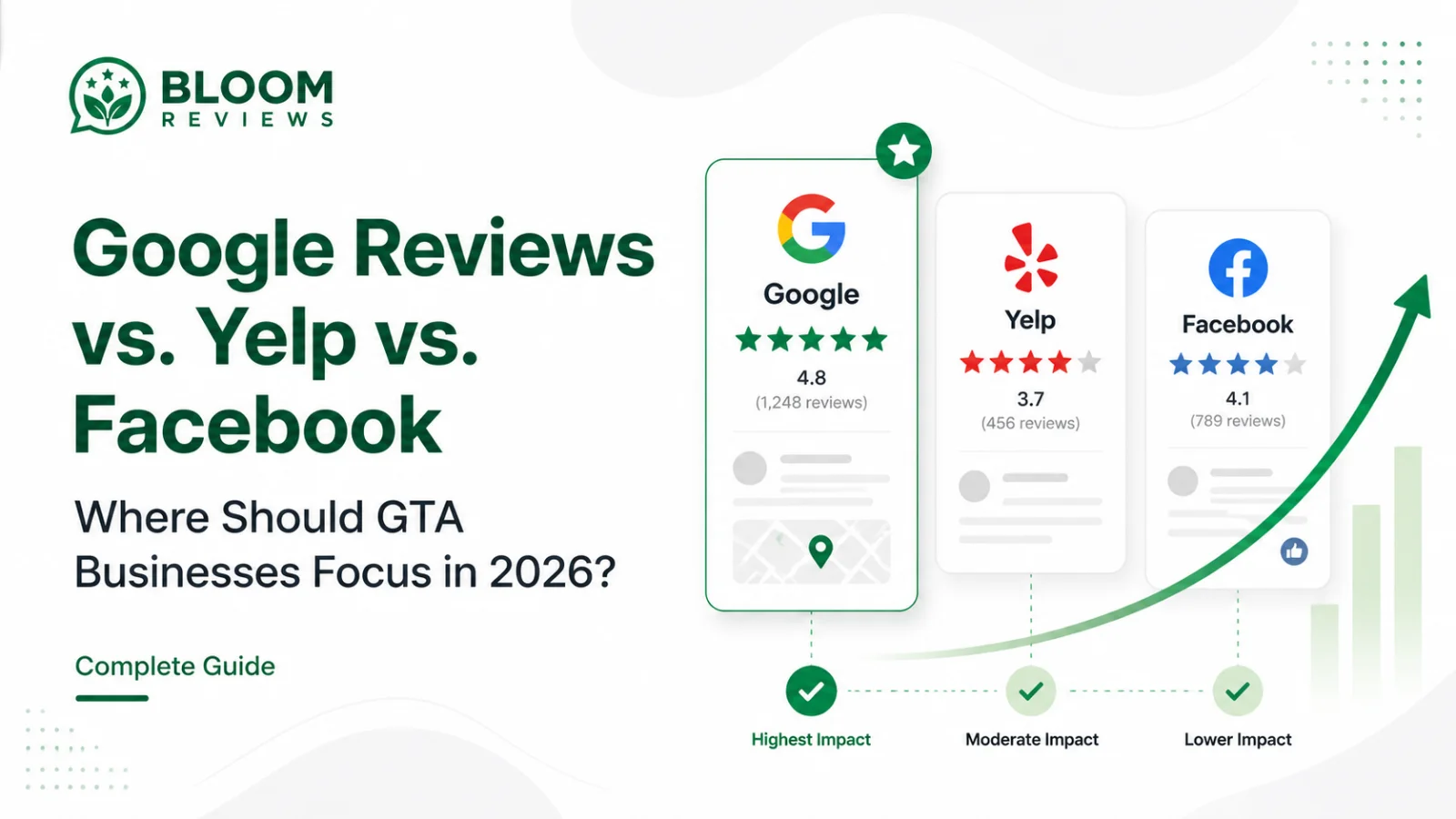
Google Reviews vs. Yelp vs. Facebook: Where Should GTA Businesses Focus in 2026?
You don't have unlimited time to chase reviews across every platform, and treating them as interchangeable is a mistake, since each one plays by genuinely different rules. Here's how to prioritize.
The Bloom team · July 2026
Business owners often try to collect reviews everywhere at once: Google, Yelp, Facebook, sometimes industry-specific sites too. Spreading requests that thin usually means none of the platforms build meaningful volume, and worse, a strategy that works fine on one platform can actively get your reviews filtered on another. Here's how to think about where your limited review-request effort should actually go, and why the platforms aren't interchangeable.
Google Business Profile: The Priority, No Contest
For almost every local business, Google should be the primary focus, and it's not close. Google Business Profile signals make up the largest share of Local Pack ranking weight, and the map pack appears above organic results for the vast majority of local searches. A customer searching "dentist near me" or "hair salon Mississauga" sees your Google reviews before they see anything else, often before they ever reach your website or any other platform.
Google reviews also feed directly into how Google's AI-driven search summaries describe your business, which matters more every year as more searches resolve through AI overviews rather than a traditional list of links. See how many Google reviews you need to rank in the local map pack for the specific data on how review signals weigh against other ranking factors.
If you're only going to build a system for one platform, it has to be Google. We cover the mechanics in how to get more Google reviews for your business and how QR codes help businesses get more Google reviews.
Yelp: Stricter Rules Than Google, Not Just a Smaller Audience
Yelp still carries real weight in a handful of categories, particularly restaurants, and in a handful of markets where Yelp usage skews higher. But the more important thing to understand about Yelp isn't its audience size, it's that Yelp's policies around review solicitation are stricter than Google's, and Yelp has been enforcing against solicited reviews for far longer.
Yelp's long-standing "Don't Ask" policy treats any prompted review as suspect, not just incentivized or gated ones. Yelp's own guidance explicitly names review gating as a prohibited practice, defined the same way Google now defines it: using a survey to route only satisfied customers to a public review while suppressing criticism through private, non-public channels. Beyond gating specifically, Yelp's recommendation software is built to detect and filter reviews it judges to be solicited at all, even a simple, non-incentivized "would you mind leaving us a review?" can trigger filtering, and filtered reviews don't count toward your visible star rating.
Yelp's detection methods go further than most business owners realize. The platform can identify traffic sent to a review page through tracked links (UTM parameters in an email or social post, for example), and treats that as a signal the review was prompted rather than organic. Reviews from employees or family members are also treated as a conflict of interest and filtered, the same conflict-of-interest logic Google now applies. Independent analysis has estimated that Yelp's filter removes a substantial share of all submitted reviews, in the range of a quarter of total submissions, which gives a sense of how aggressively the system operates even for legitimate businesses simply trying to grow their review count.
That makes Yelp a poor fit for an active request strategy. If you're in a Yelp-heavy category (restaurants and hospitality especially), the right approach is making sure your profile is claimed, complete, and monitored, rather than running active campaigns asking customers to review you there. Encouraging customers to check in on the Yelp app when they organically want to leave feedback is about as far as most businesses should push it.
Facebook Reviews (Recommendations): Useful for Community Trust, Weak for Search
Facebook's review feature, now framed as "Recommendations," rarely shows up in Google search results the way Google or even Yelp reviews sometimes do. Its main value is social proof for people already engaging with your Facebook page, not new-customer discovery through search.
For businesses with an active Facebook community, particularly ones that run local Facebook groups or get referral traffic through the platform, it's worth keeping current, but it shouldn't compete with Google for your active request effort. Unlike Yelp, Facebook doesn't apply the same aggressive anti-solicitation filtering, but the return on investment for building a dedicated Facebook review collection process is simply much lower than the equivalent effort spent on Google, given how little weight Facebook reviews carry in local search discovery.
Industry-Specific Platforms
Depending on your category, there may be a platform that matters more than any of the three above: Healthgrades or RateMDs for medical practices, Houzz for renovation and design, TripAdvisor for hospitality and tourism. If your category has a dominant vertical platform, treat it the way you'd treat Yelp: keep it claimed and current, but don't let it pull request effort away from Google unless it's genuinely where your customers are actively searching before choosing you.
A Simple Framework for Where to Focus
- Google gets the active, consistent request process. Every customer, every time, using compliant request language that avoids anything resembling gating or incentivizing.
- Yelp and industry-specific sites get claimed and monitored, with responses to what comes in organically, and no active solicitation given how aggressively Yelp in particular filters prompted reviews.
- Facebook gets kept current if you already have an active page, but isn't worth building a dedicated collection process around given its limited discovery weight.
For businesses managing this across more than one location, the same prioritization applies at each address individually, since Google ranks every location's profile independently. See managing reviews across multiple locations for how that changes the operational picture.
What Happens If You Apply a Google-Style Strategy to Yelp
This is worth calling out specifically because it's a common, well-intentioned mistake: a business that builds a strong, compliant Google review request process (every customer, no incentives, no gating) and then applies that exact same process to Yelp will likely see a meaningful share of those Yelp reviews filtered anyway, because Yelp's threshold for what counts as "solicited" is lower than Google's. A request that's perfectly compliant on Google can still get filtered on Yelp simply because it was a request at all. This is the core reason the two platforms need different strategies rather than one unified review-request campaign.
Frequently Asked Questions
Should I ever tell Yelp reviewers I'd appreciate a review? Yelp's guidelines discourage direct solicitation, and Yelp's own filtering algorithm has historically been aggressive about hiding reviews it suspects were solicited, even without any incentive attached. It's safer to focus solicitation effort on Google and let Yelp reviews accumulate organically.
Do Facebook reviews affect my Google ranking at all? Not directly. Google's Local Pack algorithm doesn't pull in Facebook review data as a ranking signal the way it does with reviews on your actual Google Business Profile.
What if most of my current reviews are on Facebook, not Google? That's common for businesses that grew through social media. It's worth starting a Google-focused request process now; existing Facebook reviews don't transfer, but Google review count can catch up quickly with a consistent, compliant process.
Is it worth paying for a reputation tool that posts to all three platforms at once? Usually not the priority. Since Google carries by far the most ranking and discovery weight, and Yelp actively penalizes solicited reviews regardless of platform origin, a tool focused specifically on building Google review volume compliantly tends to deliver more return than a scattergun multi-platform posting tool.
Does having reviews on multiple platforms build more overall trust? Some, for customers who specifically cross-check, but the effect is much smaller than the effect of review volume, recency, and rating on the single platform that dominates local discovery, which for most businesses is Google.
Why does Yelp filter reviews that Google would consider perfectly fine? Yelp's stated rationale is that any prompted review, even an honest one, tends to skew more positive than a fully organic one, so its algorithm treats solicitation itself as a bias signal rather than only targeting incentivized or gated requests specifically. Google's newer policy has moved closer to this position but still draws the line at gating and incentives rather than all solicitation.
Related reading on The Bloom Blueprint
- How to Get More Google Reviews for Your Business
- How QR Codes Help Businesses Get More Google Reviews
- How Many Google Reviews Do You Need to Rank in the Local Map Pack?
- Google's 2026 Review Policy Update: What Every Local Business Needs to Know
- Managing Online Reviews Across Multiple Locations
Want a system built specifically to grow your Google review count, where it actually matters most? See how Bloom Reviews works →
See how Bloom brings in more Google reviews.
One QR code catches happy customers before they leave. Nothing to install.
Book a demo call