Turning a 1-Star Review Into a Customer: A Response Framework Backed by Data
A negative review is a chance to win future customers. Here is a data-backed framework for responding to 1-star reviews that builds trust instead of losing it.
The Bloom team · July 21, 2026 · 4 min read
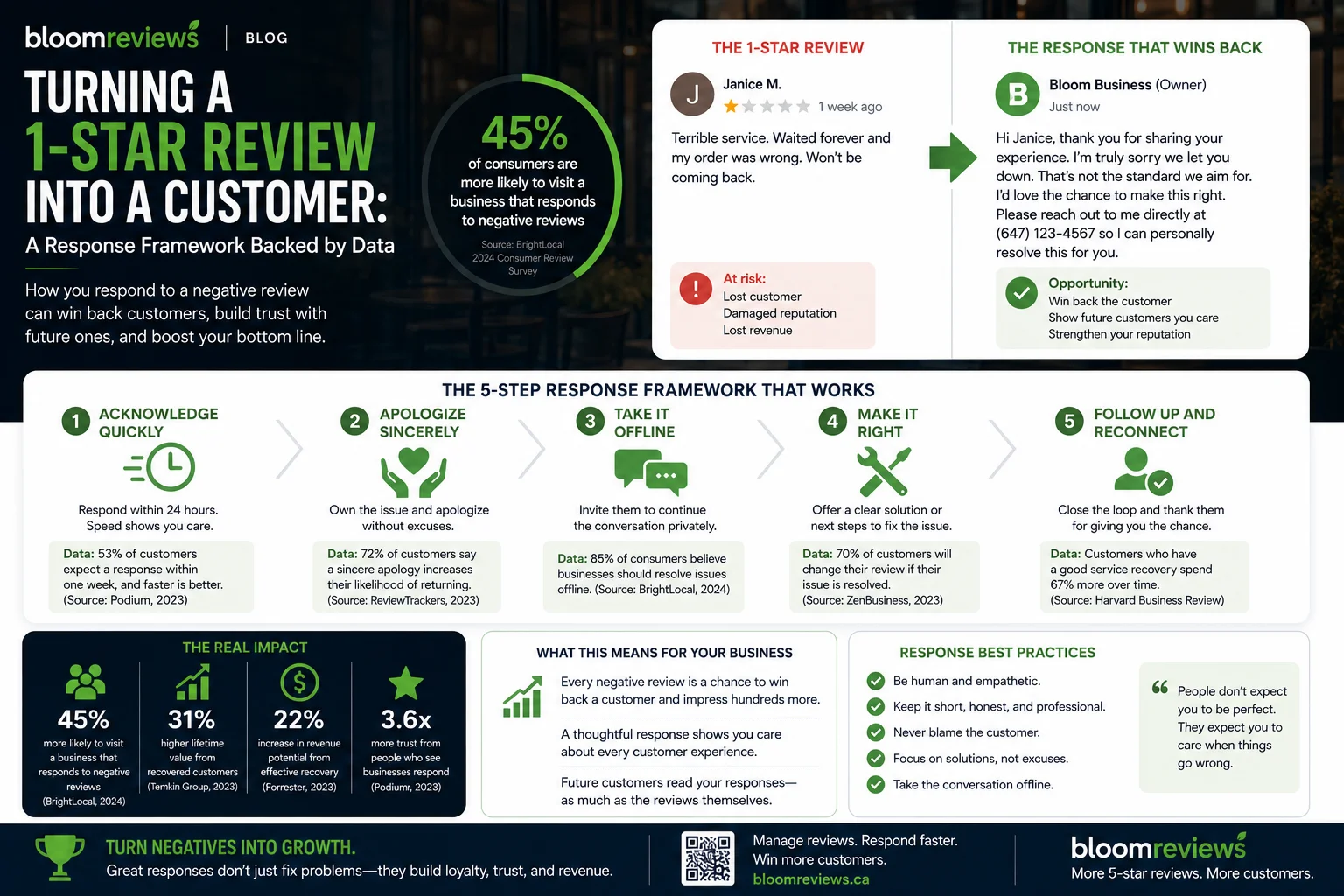
10. Turning a 1-Star Review Into a Customer: A Response Framework Backed by Data
A one-star review lands and your stomach drops. Natural reaction. But here is the reframe that changes everything. That negative review is not just about the angry customer. It is a public audition, and your real audience is every future customer who reads how you respond.
Your response is on stage
Remember this. Around 96 percent of consumers seek out negative reviews on purpose, according to research cited across the industry. They go looking for the bad ones to see what goes wrong and how you handle it.
So your response to a one-star review gets read far more than you think. And the data says it moves the needle. BrightLocal found that 88 percent of consumers would use a business that replies to all its reviews, versus 47 percent for one that does not. And 98 percent say the quality of the response influences their decision.
Translation. A great response to a bad review can win you more customers than the review costs you. It is also part of rebuilding the trust that reviews have been quietly losing.
The four-part framework
Here is a simple structure that works. Acknowledge, own, resolve, invite offline.
Acknowledge. Start by recognizing their experience without getting defensive. "Thank you for letting us know, and I am sorry your visit did not go the way it should have." You are not admitting fault for everything. You are showing you heard them.
Own. Take responsibility for the part you can. Even a simple "That is not the standard we hold ourselves to" signals accountability. Future readers are watching for whether you make excuses or take ownership.
Resolve. Say what you are doing about it. A specific fix beats a vague apology. "We have talked with the team about the wait time you ran into" shows action, not just words.
Invite offline. Give them a direct way to reach you to make it right. This moves the heated back-and-forth off the public profile and into a real conversation.
Personalize it or lose half your audience
One warning. Generic responses put off 50 percent of consumers, per BrightLocal. So a copy-paste "We are sorry for your experience, please contact us" reply does more harm than good. It reads as a bot going through the motions.
Name the specific issue. Reference the actual situation. Sound like a person who actually read the review. That is what separates a response that builds trust from one that confirms the customer's low opinion. And do it quickly, because customers now expect responses within a day or two.
The compliant private channel
You can, and should, try to resolve the issue privately. Just do it the right way.
Invite the unhappy customer to reach out directly, alongside your public response. What you cannot do is use a private feedback form as a filter that blocks unhappy customers from ever reaching Google in the first place. That is review gating, and it breaks Google's rules. The move is to respond publicly and offer a private path in parallel, not to hide the negative feedback.
Closing the loop
Here is the best-case ending. You respond well, you fix the issue offline, and the customer updates their review. It happens more than you would expect. People are often willing to revise a review when a business genuinely makes it right. So after you resolve something, it is fair to let them know they are welcome to update their review if they feel differently now. Do not pressure. Just leave the door open.
The takeaway
A one-star review is a stage, not a wound. Acknowledge, own, resolve, and invite the conversation offline, in a specific and human voice. Since 88 percent of buyers favor businesses that respond to everything and 98 percent judge you on how you respond, handling the bad reviews well is one of the most persuasive things a future customer can see.
Bloom Reviews flags negative feedback fast and gives you an AI-assisted starting point, so you can respond quickly and turn a rough moment into proof you care. Book a 15-minute demo.
Related reading: The review gating trap · The 24-hour response window · Why perfect profiles lose trust
See how Bloom brings in more Google reviews.
One QR code catches happy customers before they leave. Nothing to install.
Book a demo call