Why Only 42 Percent of Consumers Still Trust Reviews as Much as Word of Mouth
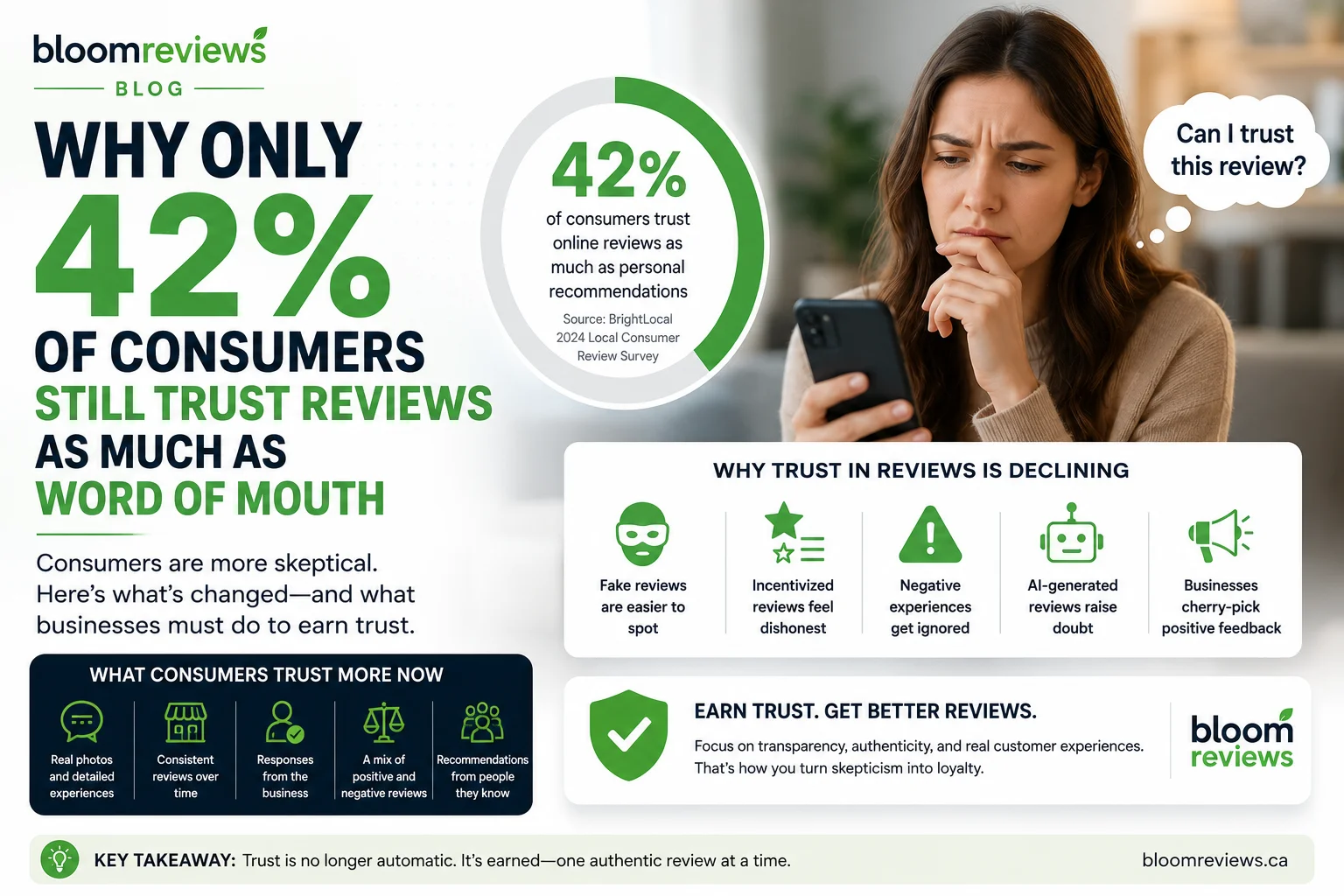
Consumer trust in reviews fell hard. In 2020, 79 percent trusted them like personal recommendations. In 2025, just 42 percent. Here is why, and how to win trust back.
Tanzim Hoque · July 21, 2026 · 3 min read
6. Why Only 42 Percent of Consumers Still Trust Reviews as Much as Word of Mouth
Here is a stat that should stop you. In 2020, 79 percent of consumers said they trusted online reviews as much as a personal recommendation. By 2025, that number had fallen to 42 percent. That is according to BrightLocal's Local Consumer Review Survey. Trust in reviews nearly halved in five years.
That does not mean people stopped reading reviews. They read them more than ever. It means they read them differently. More skeptical. More careful. And that changes what you need to do.
Why the trust dropped
People got burned. Fake reviews, paid reviews, and suspiciously perfect profiles trained buyers to be wary. Everyone has seen a business with a flawless five-star wall and thought, that cannot be real.
So buyers adapted. They stopped taking reviews at face value and started reading like investigators. They dig into the details. They look for patterns. They hunt for the catch.
The counterintuitive part
Here is where most review advice gets it wrong.
A perfect five-star profile is now a liability, not a trophy.
Research cited across the industry, including work referenced by Yuko, found that around 96 percent of consumers specifically seek out the negative reviews. They go looking for them on purpose. They want to know what goes wrong and how you handle it before they commit.
So a profile with zero negative reviews does not read as excellent. It reads as filtered. Buyers assume you scrubbed it or gated it. A handful of honest negative reviews, handled well, actually makes the positive ones more believable.
What builds trust now
If a flawless wall does not do it, what does?
Honest range. A profile that shows mostly happy customers plus a few who had issues looks like a real business, because real businesses are not perfect.
Great responses. This is the piece owners underuse. When a customer sees you reply to a complaint with care and a real fix, that response does more for your reputation than ten five-star reviews. It shows future customers what happens if something goes wrong for them. There is a simple framework for doing this well.
Personalization. And here is the trap. Generic, copy-paste responses put off 50 percent of consumers, per BrightLocal's recent survey. A templated "Thank you for your feedback, we value your business" reads as a bot. Half your readers hold it against you.
A note on AI responses
You can use AI to help write responses. In fact, BrightLocal found that when consumers were shown an AI-written response next to a human one, 58 percent preferred the AI version. So AI is not the enemy of trust here.
But the same research is clear that generic replies repel people. So use AI as a starting point, then make each response specific. Name the issue. Reference the actual visit. Say what you are doing about it. AI can draft. You make it real.
A quick trust audit
Look at your profile like a skeptical buyer would.
- Is every review five stars? If so, that is a red flag to buyers, not a win.
- Do you have any negative reviews with thoughtful responses? If not, you are missing your best trust-builder.
- Do your responses sound like a person, or like a template? Read three out loud. If they all sound the same, fix that.
- Are your reviews recent? Old reviews, even good ones, do not carry the same weight.
The takeaway
Trust in reviews fell because buyers got smart. The way back is not a perfect profile. It is an honest one, with real responses that show you handle problems like a pro. In a world where everyone is suspicious of five stars, being visibly human is the advantage.
Bloom Reviews helps you collect honest reviews and respond to them at scale, with AI summaries that give you a personalized starting point instead of a generic script. See how it works.
Related reading: The review gating trap · Turning a 1-star review into a customer · The 24-hour response window
See how Bloom brings in more Google reviews.
One QR code catches happy customers before they leave. Nothing to install.
Book a demo call