Review Recency Beats Review Count: The Local Ranking Signal Google Quietly Turned Up
Your total review count matters less than you think. Review recency is the local SEO signal Google turned up. Here is the case study and what to do about it.
Tanzim Hoque · July 21, 2026 · 3 min read
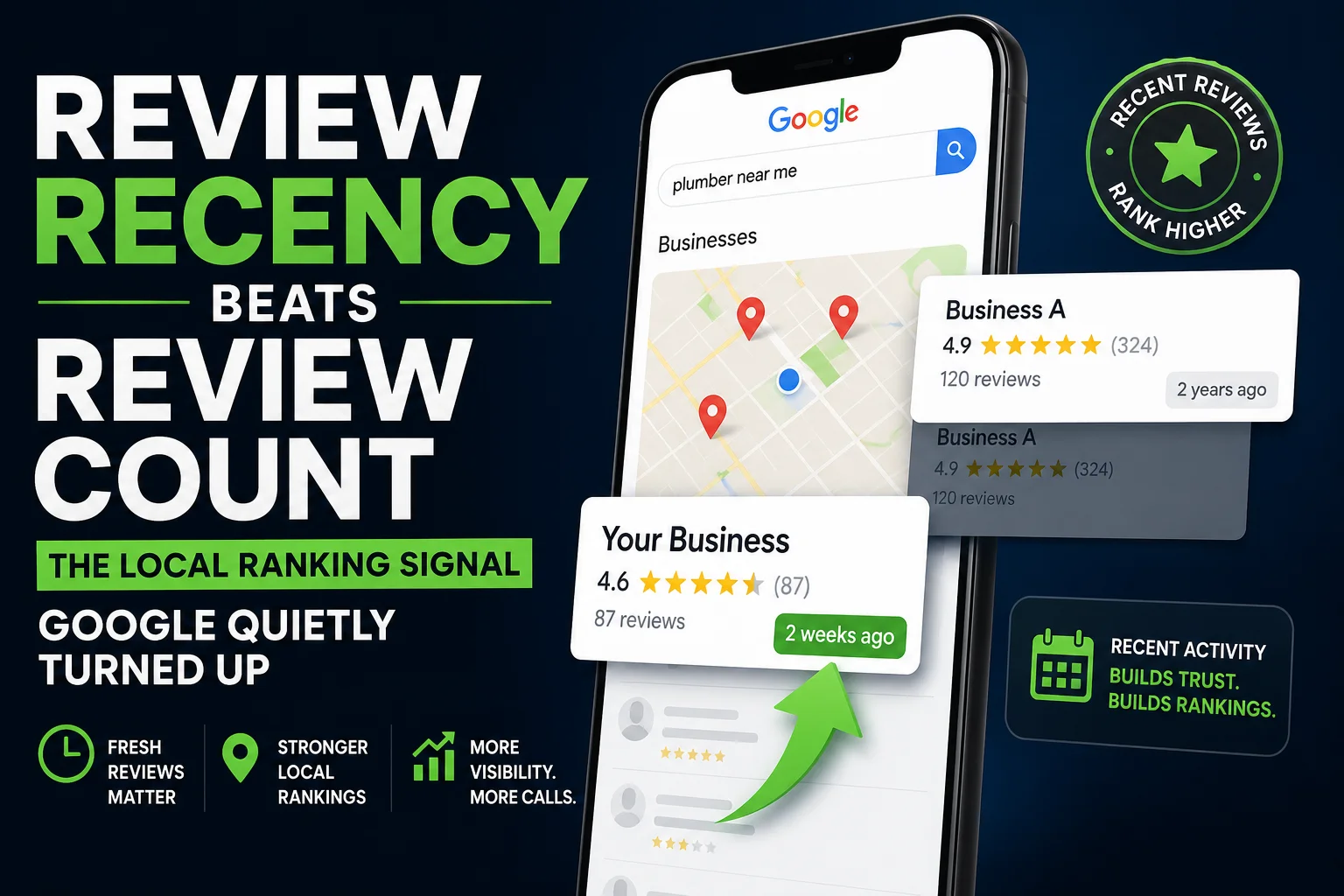
3. Review Recency Beats Review Count: The Local Ranking Signal Google Quietly Turned Up
Most owners obsess over one number. Total reviews. They want to beat the shop down the street on count. That is the wrong scoreboard. The signal Google has been quietly turning up is not how many reviews you have. It is how fresh they are.
The claim
Forty fresh reviews can outrank four hundred stale ones.
That sounds backwards until you look at how local search actually works now. Whitespark, one of the more respected voices in local SEO, has said Google has cranked the dial on review recency and puts it inside their top five ranking factors. Review velocity and response quality can matter more for visibility than raw count, according to reporting from firms like PushLeads.
The case study that proves it
There is a well-known case study, originally from Joy Hawkins and cited by Whitespark, that shows the pattern cleanly.
A business owner was rewarding staff for encouraging reviews. New reviews came in steadily. Rankings were strong. Then the owner stopped the reward. Reviews slowed. Rankings dropped. The owner started the reward again. Reviews picked back up. Rankings recovered.
Read that sequence again. Reviews up, rankings up. Reviews stall, rankings fall. Reviews resume, rankings return. It is about as direct a correlation as you get in local SEO.
Why recency matters to Google and to customers
For Google, a steady flow of recent reviews is a signal that a business is active, real, and still serving customers well. A profile that got fifty reviews three years ago and nothing since looks like a business that peaked and coasted.
For customers, recency matters even more directly. People now focus on reviews posted in the last month. According to BrightLocal's consumer research, recent reviews carry more weight than old ones. A five-star review from two years ago does not reassure someone the way a strong review from last week does. Things change. Owners change. Staff change. Buyers know that. Recency is also one of the signals that decides whether Google's AI Overview names your business.
What a healthy cadence looks like
You do not need a flood. You need a rhythm.
The right pace depends on your volume. A busy restaurant should be collecting reviews most weeks. A home services business that runs a handful of jobs a day should be asking after most of them. A clinic with steady appointments should build the request into the visit. If you are not sure what a competitive count looks like for your category, here is how many reviews businesses like yours actually need.
The goal is simple. Never let your most recent review get old. If the newest review on your profile is more than a few weeks back, you have a recency problem, even if your total count looks healthy.
How to make it a habit without nagging
The mistake is treating reviews as a campaign you run twice a year. That creates exactly the spiky pattern Google can flag, and it lets recency lapse in between.
Build it into the job instead. Ask right after the work is done, while the experience is fresh. Use a QR code or a quick link so it takes seconds. Make it part of closing out every job, not a separate marketing push you remember once a quarter.
And keep it steady. A drip of a few reviews a week beats a burst of thirty in a day, both for rankings and for staying out of Google's spam filters.
The takeaway
Stop chasing a bigger number. Start protecting your freshness. The businesses that win local search are not the ones with the biggest review pile. They are the ones whose newest review is always recent.
Bloom Reviews turns collection into an always-on system, so your profile never goes stale. See what that looks like on your business.
Related reading: Getting cited in Google's AI Overview · How many reviews you actually need · The 24-hour review response window
See how Bloom brings in more Google reviews.
One QR code catches happy customers before they leave. Nothing to install.
Book a demo call