How Many Google Reviews Does a Restaurant, Dentist, or Home Service in the GTA Actually Need?
Not all businesses need the same number of reviews. Our own Toronto benchmark shows what the top businesses in each category carry, plus how to set a realistic target.
Tanzim Hoque · July 21, 2026 · 6 min read
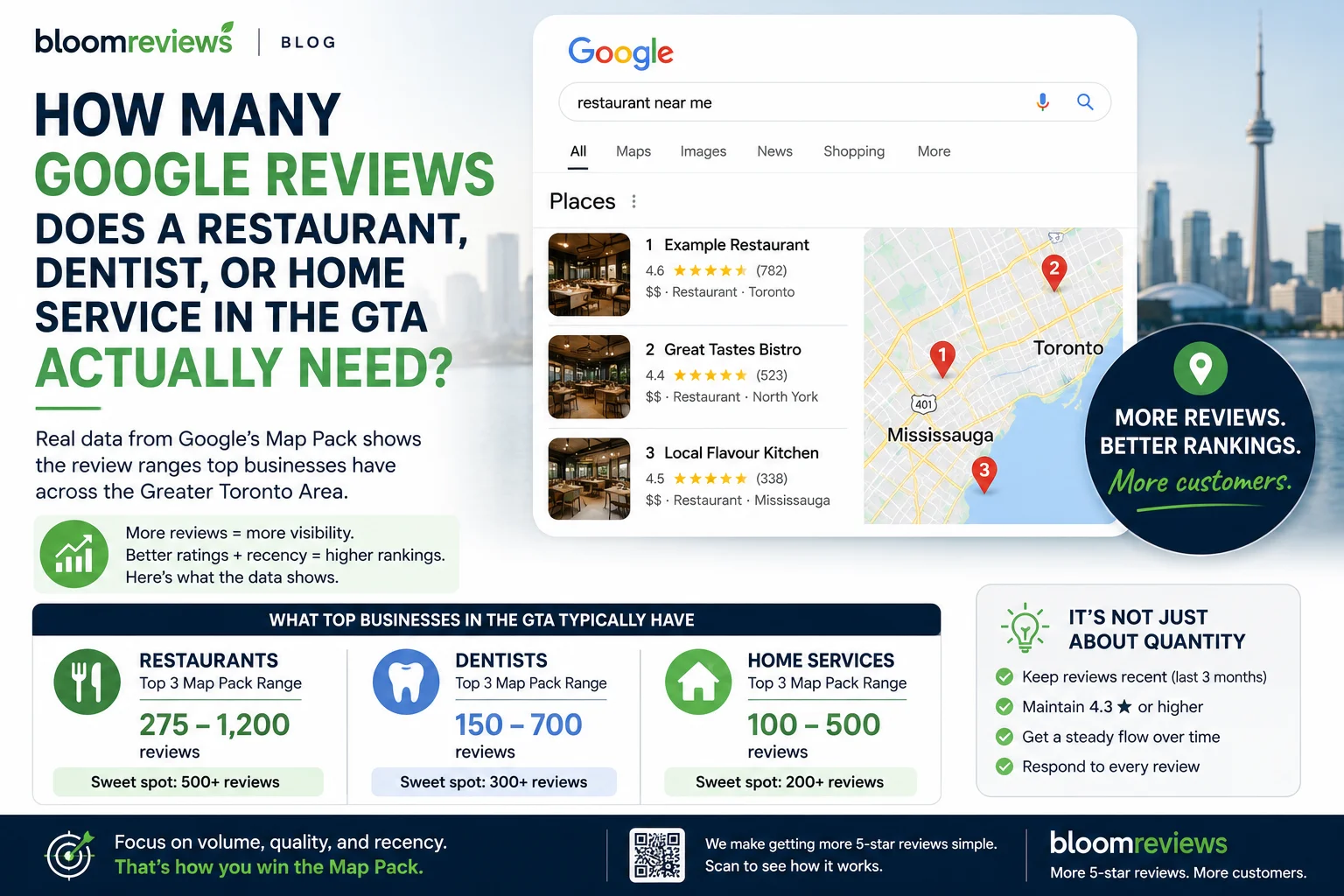
8. How Many Google Reviews Does a Restaurant, Dentist, or Home Service in the GTA Actually Need?
"How many Google reviews do I need?" is the question every owner asks and no generic article answers well. The honest answer is that it depends on your industry and your area. A dentist in Mississauga does not need the same number as a restaurant in downtown Toronto. So let us answer the real question instead of the lazy one.
The wrong question and the right one
The wrong question is "how many reviews should a business have?" There is no single number.
The right question is "how many reviews does a business like mine, in an area like mine, need to compete?" That is answerable, and it is far more useful.
Here is why it varies. Research from Search Atlas, using machine learning across industries, found that proximity sets the baseline for local rankings, reviews are what differentiate businesses from their competitors, and sector-specific strategies outperform generic ones. In other words, the number that makes you competitive is set by your category and your neighbors, not by some universal rule.
The trust threshold buyers use
There is one number worth knowing across the board. Around 33 percent of consumers say a business needs somewhere between 20 and 49 reviews before they will trust it, per BrightLocal's research.
So the floor to look credible to a big chunk of buyers is roughly 20 to 50 reviews. Below that, a third of potential customers do not take you seriously yet. That is your first milestone, whatever your industry.
But the floor is not the finish line. To rank and to beat local competitors, you usually need to look at what the businesses ranking above you have, and clear that bar.
What the top businesses in your category actually carry
We ran our own analysis to answer this properly. In July 2026 we searched Google for "top [category] in Toronto," took the three highest-rated results in each category, and recorded their review counts and star ratings. This is a dated snapshot, not a law of nature. Google results shift by location, distance, and search history. But it gives you a real read on what the visible leaders in each category carry right now.
Here is what the top-ranked businesses looked like.
| Category | Typical (median) reviews | Typical rating | Range we saw |
|---|---|---|---|
| Restaurants | 5,887 | 4.8 | 1,422 to 12,862 |
| Dentists | 832 | 5.0 | 188 to 1,511 |
| Coffee shops | 294 | 4.8 | 103 to 314 |
| Hair salons | 196 | 5.0 | 163 to 390 |
| Plumbers and home service | 170 | 5.0 | 56 to 1,190 |
A few things jump out.
There is no universal number. The typical top business ranges from about 170 reviews for plumbers to nearly 6,000 for restaurants. A salon comparing itself to a restaurant is chasing the wrong target.
Restaurants face the highest bar by far. Even the smallest restaurant in our sample had over 1,400 reviews, and the leaders ran into the tens of thousands. If you run a restaurant, plan for volume in the thousands to lead your market.
Rating is the real gatekeeper. Every one of the 15 businesses we looked at held at least 4.7 stars, and 11 of the 15 sat at 4.9 or 5.0. Now, we sorted by rating, so high ratings in our sample are partly by design. But broader research confirms the pattern holds market-wide. A Local Falcon analysis of 50 million search results found that star ratings cluster tightly between 4.5 and 4.9 across almost every category, and that dropping below about 4.3 makes it very hard to rank at all. See Local Falcon's 50-million-result study.
Count is the differentiator, not the entry ticket. Here is the nuance most articles miss. In our dentist sample, one practice ranked near the top with just 188 reviews, sitting right next to a competitor with 1,511. How? A perfect 5.0 rating. The lesson is simple. A strong rating can beat a big pile of reviews. You do not have to out-count the biggest player. You have to clear the rating bar first, then build count to compete among the leaders.
Use the median, not the average. One dominant competitor can distort a whole category. Toronto plumbers averaged 472 reviews in our sample, but the median was only 170, because a single business had 1,190. For setting your own target, the median is the more realistic starting line.
The number to actually aim for
There are two numbers worth knowing, and they are very different.
The entry number is lower than you think. That same Local Falcon study of 50 million results found the median business appearing in the local three-pack had around 47 reviews. Read that again. You can start showing up in the map results with far fewer reviews than the category leaders carry, as long as your rating is strong.
The leader number is what the table above shows. That is where you go to dominate your category, not where you start.
So set two targets, in order. First, clear the trust floor and the entry bar together: roughly 20 to 50 reviews with a rating above 4.3. That gets you visible and credible. Then climb toward the category median in the table to compete with the established leaders over time. One is a sprint. The other is a campaign.
How to set your own target
You do not need to guess. Do this.
- Search your main service plus your city, the way a customer would.
- Look at the three businesses ranking above you in the map pack.
- Note their review counts. That is your real target, because those are the businesses you are actually competing with.
- Set a 90-day goal to close the gap, at a steady pace rather than a burst.
That approach beats any generic number, because it is calibrated to your exact market. And once you hit the count, keep the flow steady so your reviews stay recent, which is its own ranking signal.
If you are starting from zero
A blank profile feels daunting. Break it down.
Your first milestone is the trust floor, 20 to 50 reviews, so you stop looking new. At a steady pace of a few real reviews a week, most local businesses can get there in a couple of months. After that, you shift from catching up to pulling ahead of your top local competitors. Remember, every rating point you gain along the way is worth real revenue.
The takeaway
Stop asking how many reviews businesses need in general. Ask how many businesses like yours, in your area, need to win. The trust floor is roughly 20 to 50. The real target is set by the competitors ranking above you. Everything past that is compounding advantage.
Bloom Reviews helps GTA businesses hit that first trust threshold fast, then keep building past their local competitors. Book a 15-minute demo.
Related reading: Review recency and why it beats count · The real dollar value of one star · Where GTA consumers actually check reviews
See how Bloom brings in more Google reviews.
One QR code catches happy customers before they leave. Nothing to install.
Book a demo call