What Canada's Competition Act Says About Fake Reviews, and the $1.5 Million Penalty Most Owners Never Heard About
Fake reviews can break Canadian law, not just Google's rules. Here is what the Competition Act says, the enforcement case that cost $1.5 million, and how to stay clean.
Tanzim Hoque · July 21, 2026 · 4 min read
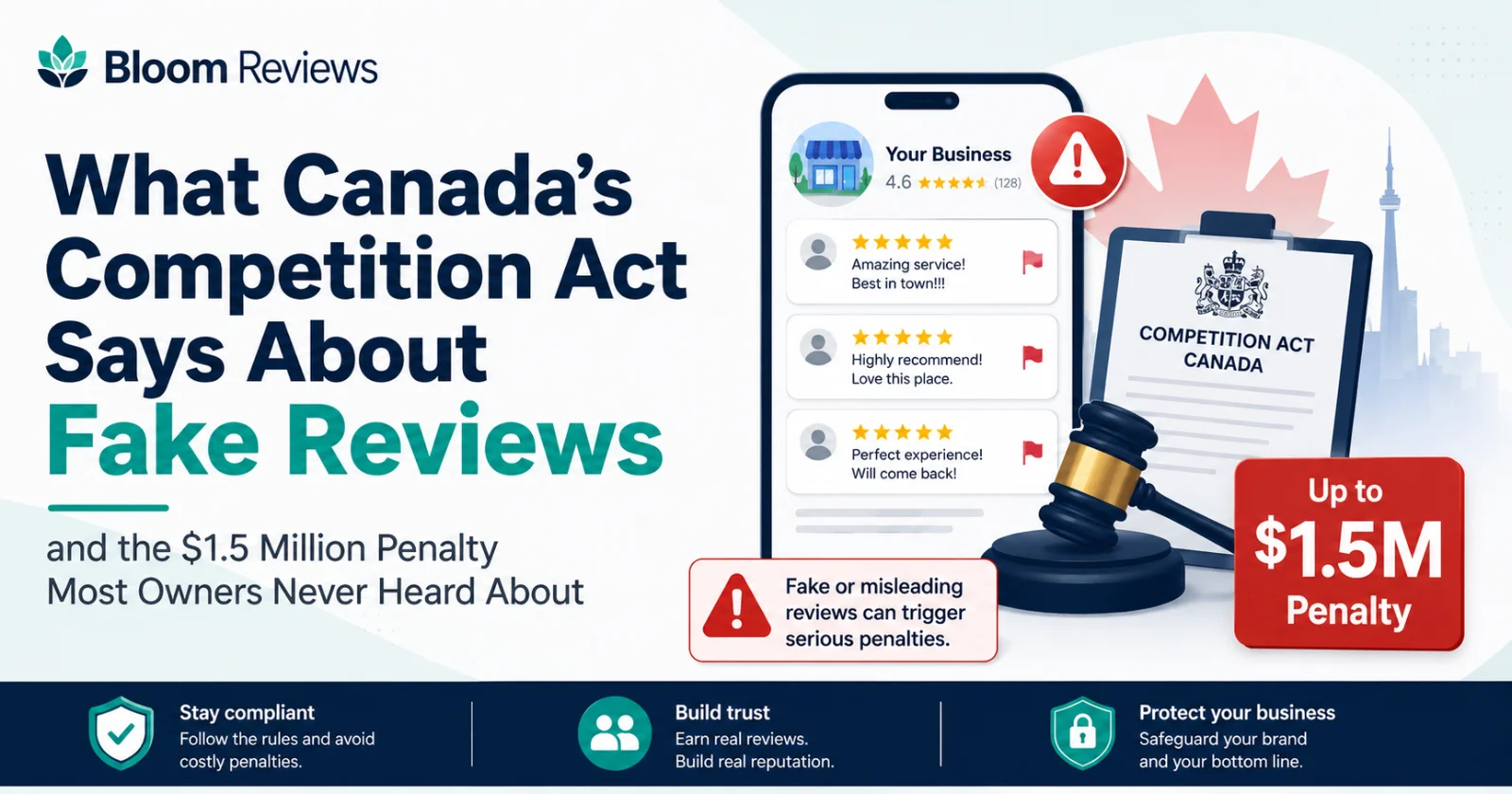
What Canada's Competition Act Says About Fake Reviews, and the $1.5 Million Penalty Most Owners Never Heard About
Search "fake reviews" and almost everything you find is about the United States. The FTC this, the FTC that. If you run a business in Canada, that is not your law. Your law is the Competition Act, and it has teeth. Most owners in the GTA have never heard about the case that proves it.
Yes, fake reviews can be illegal in Canada
The Competition Act governs business conduct in Canada. Its deceptive marketing provisions apply to anyone promoting a product, service, or business interest. Fake or misleading reviews fall squarely inside that.
This is not a gray area. The Competition Bureau, which enforces the Act, has said clearly that false or misleading reviews mislead consumers and harm competition. That makes them a target for enforcement.
The Amp Me case
Here is the case worth knowing.
Amp Me is a Montreal company behind a mobile app that syncs devices to boost sound. In December 2023, the Competition Bureau announced a settlement over concerns that Amp Me had purchased positive reviews from third parties between 2019 and 2022 to promote its app. The Bureau found those reviews created a false impression and influenced the app's ranking and rating.
The penalty imposed was 1.5 million dollars. Amp Me settled with a partial payment of 310,000 dollars plus 40,000 dollars in costs, under an agreement that carries the force of a court order for ten years.
Sit with that number. A company bought reviews, got caught, and ended up on the hook for a penalty measured in the hundreds of thousands. This is the enforcement reality Canadian businesses rarely hear about.
The employee review trap
Here is the one that catches honest businesses by accident.
In January 2024, the Competition Bureau warned that employees who post reviews about their own employer, or about competitors, must disclose that relationship. Even if the review is their genuine opinion. If an employee leaves a glowing review of your business without saying they work for you, that can create a false impression. Under the Act, both the employee and the business can be liable.
Think about how easily this happens. A proud team member leaves a five-star review. No bad intent. Still a problem, because the reader has no idea they are reading an employee.
The Bureau's guidance is simple. Material connections have to be disclosed. If someone cannot make that connection clear inside the review, they should not post it.
Why the risk is rising
Recent amendments to the Competition Act increased the penalties for civil misleading representations. The Bureau has also made misleading advertising an enforcement priority. On top of that, the Bureau and the US FTC often collaborate and share views, so tougher US enforcement tends to signal where Canada is heading.
Translation. The cost of getting this wrong is going up, not down.
How to stay clean
A short checklist for a GTA small business.
- Never buy reviews. Not from a service, not from a marketplace, not from a friend of a friend.
- Never offer a discount, gift, or draw entry in exchange for a review. That is an incentive, and it creates a misleading impression.
- Tell your team the disclosure rule. If they review the business, they must say they work there. Better yet, ask them not to review it at all.
- Only ask real customers, and ask all of them the same way. Filtering by sentiment is review gating, which is its own problem.
- Keep a simple record of how you collect reviews, so you can show your process is honest if anyone ever asks.
The takeaway
Fake reviews are not just a Google problem in Canada. They are a legal one. The businesses that treat review collection as a clean, honest, well-documented process are not just protecting their rating. They are protecting themselves from a law most of their competitors do not even know exists. And since a single honest rating point is worth real revenue, there is no upside to faking it.
Bloom Reviews helps GTA businesses collect real reviews from real customers, the honest way. See how the process stays clean.
Related reading: The review gating trap · The real dollar value of one star · Turning a 1-star review into a customer
See how Bloom brings in more Google reviews.
One QR code catches happy customers before they leave. Nothing to install.
Book a demo call