The Real Dollar Value of One Star: What a Rating Bump Is Worth to Your Business
A one-star rating increase is worth 5 to 9 percent in revenue, per Harvard research. Here is the math applied to a local service business, and why the first 50 reviews matter most.
Tanzim Hoque · July 21, 2026 · 3 min read
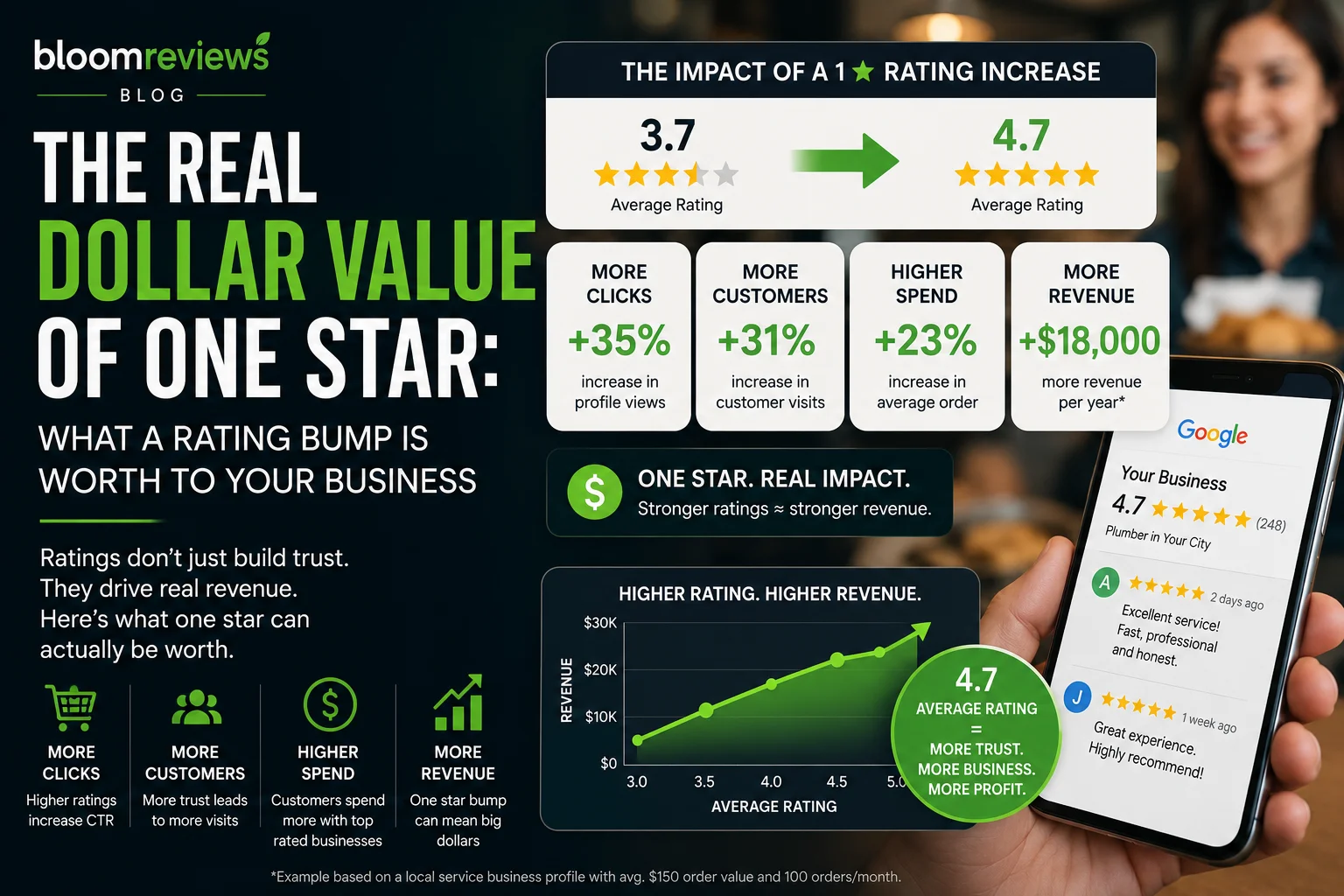
5. The Real Dollar Value of One Star: What a Rating Bump Is Worth to Your Business
Owners ask me the same thing all the time. Are reviews really worth the effort? Fair question. Most review advice hand-waves the answer. So let me give you a real number, from a real study, and then do the math on what it means for your business.
The Harvard number
A Harvard Business School study by Michael Luca looked at how ratings affect revenue. The finding was clean. A one-star increase in rating led to a 5 to 9 percent increase in revenue.
Read that again. Not a 5 to 9 percent increase in reviews. In revenue. Actual money through the door.
The study also found something important for you specifically. That effect was driven by independent businesses, not chains. Big chains have decades of brand reputation, so a rating change barely moves them. Independent local businesses live and die by their reviews, because reviews are often the only reputation signal a new customer has. If you are a local service business, you are exactly the type this effect hits hardest, in the good way.
The math on your business
Let us make it concrete. This is illustrative, so plug in your own numbers.
Say your business does 500,000 dollars a year in revenue. A one-star improvement, using the low end of 5 percent, is worth 25,000 dollars a year. At the high end of 9 percent, it is 45,000 dollars.
Now scale it. If you do a million a year, that same one-star move is worth 50,000 to 90,000 dollars.
You do not usually jump a full star overnight. But you do not have to. To put a real number on it, Bloom's own data shows an average shift from 3.8 to 4.6 stars in the first 90 days across businesses using it. That is most of a full star, inside a single quarter. Even moving from a 4.1 to a 4.4 is a meaningful slice of that revenue range.
Why the first 50 reviews matter most
Here is a second finding worth knowing. Follow-up research on Luca's work suggests a rating change has a much larger impact once a business has around 50 or more reviews. Roughly 50 percent more impact, in that work.
The takeaway is not "get to 50 and stop." It is that the early reviews do double duty. They build the volume that makes your rating credible, and past that threshold, every rating movement pulls more weight. The first 50 are the foundation. Everything after compounds. If you want to know where your category lands, here is how many reviews a business like yours needs.
What customers do before they trust you
To understand why the effect is so strong, look at how people actually shop. Consumers spend real time on this. Industry research points to buyers reading around ten reviews and spending well over ten minutes before they decide to trust a local business.
That is a lot of scrutiny. Your rating is the headline that decides whether they even start reading. A higher rating gets more people to stop and consider you. More consideration, more customers, more revenue. That is the whole chain.
The one catch
There is a wrong way to chase this. Buying reviews. Faking a bump. Gating out the unhappy customers so your average looks inflated.
Do not. It breaks Google's rules and, in Canada, it can break the law under the Competition Act. The revenue effect Luca found came from real ratings earned honestly. A faked bump is a liability, not an asset.
The takeaway
One star is worth real money, especially for an independent local business. The first 50 reviews build the base, and every honest rating improvement after that pulls more weight. Reviews are not a vanity metric. They are one of the highest-leverage things you can work on.
Bloom Reviews makes earning that bump systematic. See the pricing against the revenue math, and the ROI case writes itself.
Related reading: How many reviews you actually need · The review gating trap · Canada's law on fake reviews
See how Bloom brings in more Google reviews.
One QR code catches happy customers before they leave. Nothing to install.
Book a demo call